Designing a Connector linking Salesforce, Voice SoftSwitch and Voice SDK for a 500-agent Contact Center (2024)
A purpose-built Connector that fuses Salesforce CRM, the carrier-grade Voice SoftSwitch and a browser Voice SDK into a single agent workflow — click-to-dial, screen-pop, call control and full activity logging for 500 agents.
Challenge → Solution → Outcome
Step-by-step view of how we moved from the brief to the outcome.
A 500-agent contact center ran Salesforce as the source of truth for customers, a carrier-grade Voice SoftSwitch for telephony, and a separate softphone — three systems, three logins, manual after-call work. Existing off-the-shelf CTI adapters did not speak the customer's SoftSwitch dialect and could not survive a 500-seat concurrency profile.
Problem. Solution. Result.
A 500-agent contact center ran Salesforce as the source of truth for customers, a carrier-grade Voice SoftSwitch for telephony, and a separate softphone — three systems, three logins, manual after-call work. Existing off-the-shelf CTI adapters did not speak the customer's SoftSwitch dialect and could not survive a 500-seat concurrency profile.
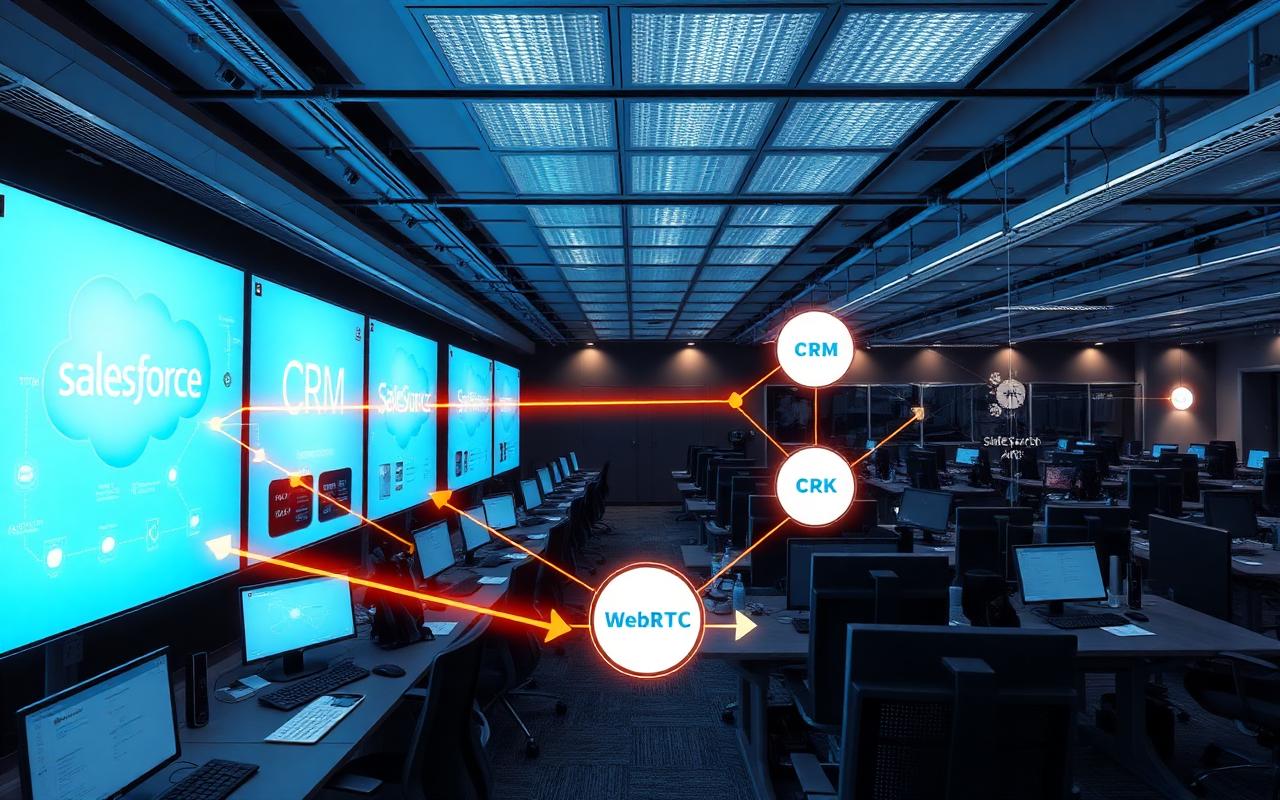
- 01Designed a 3-leg Connector: Salesforce Open CTI ↔ Connector core ↔ SoftSwitch (SIP/REST) + Voice SDK (WebRTC).
- 02Single sign-on across Salesforce and the Voice SDK; per-agent device registration handled by the Connector.
- 03Click-to-dial from any Salesforce object; inbound calls trigger screen-pop with matched contact/case in <1s.
- 500 agents migrated to a single unified desktop — softphone retired.
- Average handle time down materially thanks to screen-pop and click-to-dial.
- After-call work effectively zero — dispositions and recordings land in Salesforce automatically.
Solution
- 01Designed a 3-leg Connector: Salesforce Open CTI ↔ Connector core ↔ SoftSwitch (SIP/REST) + Voice SDK (WebRTC).
- 02Single sign-on across Salesforce and the Voice SDK; per-agent device registration handled by the Connector.
- 03Click-to-dial from any Salesforce object; inbound calls trigger screen-pop with matched contact/case in <1s.
- 04Call control surface (answer, hold, transfer, conference, mute) exposed both as Salesforce widget and as a JS API for embedded apps.
- 05Activity logging is atomic — every call writes a Task with disposition, duration and recording URL to Salesforce.
- 06Horizontal-scaled Connector tier sized for 500 concurrent agents with HA pair per region.
Outcome
- 500 agents migrated to a single unified desktop — softphone retired.
- Average handle time down materially thanks to screen-pop and click-to-dial.
- After-call work effectively zero — dispositions and recordings land in Salesforce automatically.
- Reusable Connector pattern adopted later for IVR + bot integrations on the same SoftSwitch.
Measurable shift
Inside the engagement
Off-the-shelf adapters all failed our SoftSwitch dialect or our concurrency. The custom Connector spoke both sides natively from day one.